



CREEED and partners launch Ascend to strengthen student pathways from high school to postsecondary credentials and high-demand careers.
By: Ivette Savina, Ascend Program Director
BUILDING A TALENT STRONG EL PASO
El Paso’s economy is growing, and with it, the demand for skilled workers in healthcare, technology, advanced manufacturing, construction, and trades. To meet this need, CREEED and partners launched the Ascend program to strengthen student pathways from high school to postsecondary credentials and high-demand careers.
The Ascend program brings together four pilot independent school districts (Anthony, Canutillo, Socorro, and Ysleta) with El Paso Community College (EPCC), CREEED, employers, and philanthropic partners to strengthen the institutional handoffs that move students from high school preparation into postsecondary credentials of value and high-demand regional careers.
INVESTING IN TALENT OUTCOMES
To meet the growing demand for skilled workers at the state level, Texas adopted Building a Talent Strong Texas, a long-term plan to align higher education with workforce needs. To support this strategy, they passed outcomes-based funding (House Bill 3 or HB3 and House Bill 8 or HB8) to incentivize districts and community colleges to implement processes that increase the number of students receiving post-secondary credentials. However, the state didn’t provide a roadmap or pathway for how educators could achieve the required results. That’s why Ascend was created and why this regional effort is so important.

CLOSING THE COORDINATION GAP
As part of these incentives across Texas K-12 and higher education, both systems play essential roles in preparing and supporting students. The coordination gap is the space between those systems: the institutional handoffs where responsibility shifts from one organization to another. Each institution owns its part of the work, but no single institution owns the transitions between them.
Without clear ownership of the handoff between these responsibilities, students can fall off the pathway, failing to receive the education they need for in-demand careers, and causing both institutions to lose the outcome and the funding tied to it.
INCREASING OUTCOMES AND SECURING MORE FUNDING
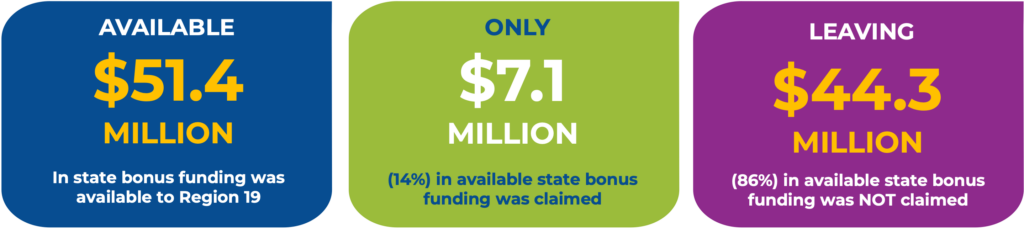
The coordination gap carries a measurable financial cost: substantial state funding remains unclaimed. In El Paso, of the $51.4 million available for the Class of 2024, only $7.1 million — 14% — was accessed, leaving $44.3 million unclaimed by regional education institutions.
WORKING TOGETHER AS A REGION
CREEED commissioned a landscape analysis to answer a central question: How can stronger coordination between El Paso school districts and El Paso Community College help more students complete postsecondary credentials in high-demand fields while enabling both systems to access the incentive funding available?
The analysis reached the same conclusion across all partners. The region has strong student preparation and career and technical education programs already in place, but the coordination needed to convert that preparation into college enrollment and completed credentials is not. The infrastructure connecting K-12 and higher education lacked clear ownership, dedicated funding, and shared data. From this conclusion emerged seven findings and eleven recommendations.
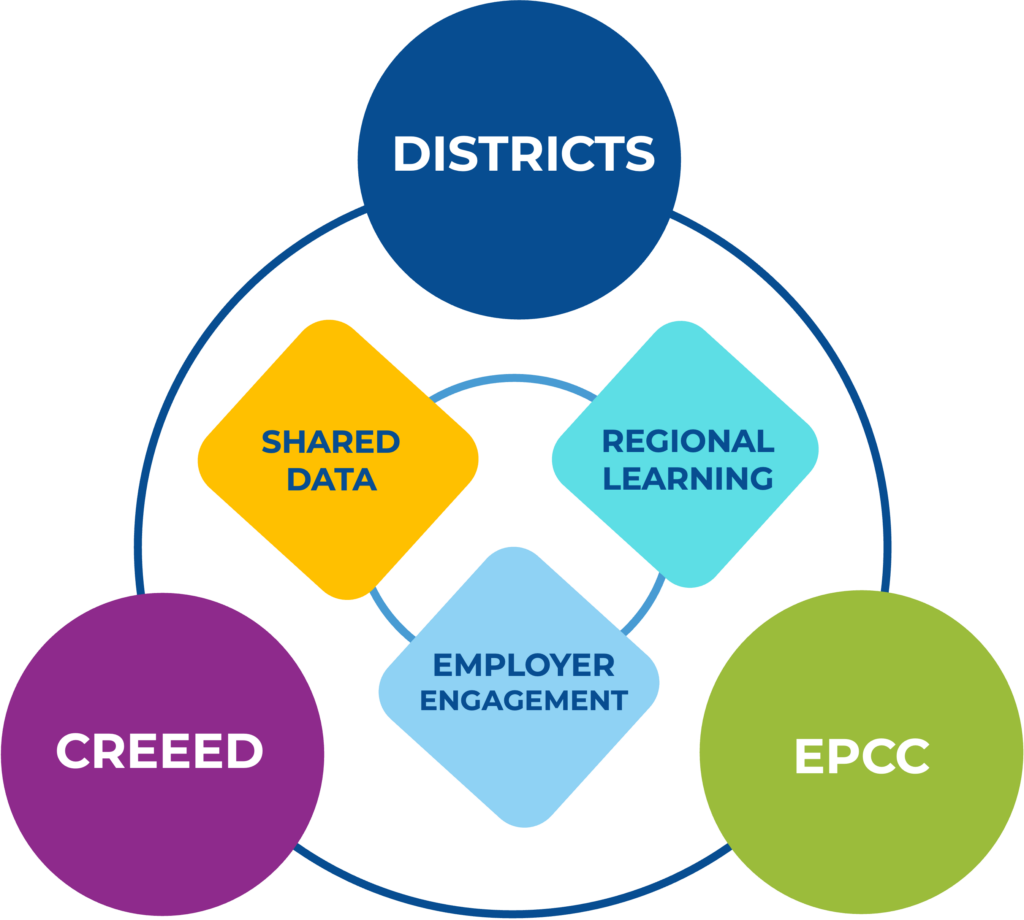
Ascend includes six interconnected components, bringing together three institutional anchors and three shared regional functions as one coordinated system. Each entity contributes distinct capacity, while shared accountability, regional learning, and employer engagement connect their work across institutional boundaries. Together, the six components address the points where student progress from high school preparation for credential completion can otherwise stall.
FOSTERING ALIGNMENT: THE ASCEND PARTNERSHIP
Ascend is the regional implementation partnership created to put the findings and priority recommendations into action and ensure our region is taking advantage of the funding available from the state for these two policy initiatives. Through Ascend, partners collaborate to improve student outcomes and more fully realize the opportunities created through Texas House Bill 3 (HB3) and Texas House Bill 8 (HB8).
IMPLEMENTING AND PROGRESSING OVER TIME
Ascend follows a three-year progressive timeline designed to build, refine, and sustain the system.

INVESTING IN OUR REGION’S STUDENTS & ECONOMIC FUTURE
CREEED has committed to securing and providing more than $1 million to launch Ascend and build the regional infrastructure required to connect district and college efforts. We gratefully acknowledge the GECU Foundation and Trellis Foundation for your investments. Philanthropic investments support coach grants, regional program leadership, shared data systems, professional learning, and the implementation of resources needed to coordinate work across institutional boundaries.
The districts co-invest beginning in year one, contributing to the majority of coach compensation and fully funding the position after year three. El Paso Community College contributes to the coordinator role and additional in-kind support. This shared investment model gradually embeds responsibility within the participating institutions while stronger student outcomes increase their opportunity to access HB3 and HB8 funding.
For additional information on Ascend, please download the Ascend Report. For a deeper understanding of the landscape analysis findings, you can download the Landscape Analysis.